Early summer slump
"I used to feel, at those times, talking to him, as if I were trying to climb a steep sand dune, while he stood on the crest: exultant in his misery." - Gwendoline Riley

Before I get into it: a very important announcement! Metonymy Press, home to my book, is doing its first ever funding drive. It’s a small but mighty independent queer- and trans-run publisher that has been surviving on the strength of its catalogue and the ingenuity and dedication of its two founders, Oliver and Ashley. Recently, my partner Eli Tareq took over Ashley’s spot so that Ashley could pursue other career avenues. The delightful and discerning Cason Sharpe recently joined the editorial committee (which I am also part of). There’s a lot of energy to keep the press running and publishing—all that’s needed is MONEYYYYYY.
Ashley Obscura of Metatron Press (yes, another Montreal indie press headed by an Ashley), has written about the massive challenges facing small queer risk-taking presses in Canada. I recommend reading her newsletter if you’re interested in learning about the frustrating context we find ourselves in.
If you care about bold, horny, weird, ungainly queer and trans literature, you can:
donate to Metonymy’s Go Fund Me
come to a fundraiser reading and karaoke party THIS FRIDAY July 3, 6:30 pm at articule (6282 rue St-Hubert): I’ll be reading (and singing karaoke if you’re lucky) alongside Eli Tareq El Bechelany-Lynch, Adjani Poirier and Nora Treatbaby, who’s coming all the way from NYC
buy Metonymy’s books (either from the press’s website or from indie book stores) or become a yearly subscriber
*
Summer has never been my favourite season (too hotttt) but this year, I’m feeling even more exhausted by it than usual—and we’ve barely hit July.
The Palestine-solidarity-related court case in which I’m a defendant (which I wrote about in my previous newsletter) is on pause until October, which I had hoped would bring about some relief and renewed personal energy. Instead, I have been totally drained—low in both interpersonal ability and personal resilience: tired from day to day for no immediately apparent reason, beset by aches, accidentally socially abrasive, easily irritated, sensorially agitated, abandoning the routines that normally help me, and just generally not at my sharpest. It doesn’t help that my professional-artistic life has been weighed down by rejections and limbos lately. Earlier this week, I spent a day waiting in the ER for a minor but acute health situation (I’m fine!). That particular experience of waiting actually felt less stressful than my professional waiting because for once, I was rewarded by a clear diagnosis (certainly not always the case in my healthcare experience, therefore extra appreciated).
I do have a new story out in the Toronto Review, the cool new lit mag on the block. “The Lilacs Again,” is one of my attempts to centre smell in fiction. Incidentally, it’s also a story about the intolerable nature of limbo. You can read it here: https://thetorontoreview.ca/the-lilacs-again-short-story/
As I wait, I worry and ruminate. How to go on, with all this tiredness (collective)? All this repression? The stakes get higher and the punishments harsher. Climate change is killing people all over the world while tech oligarchs shit out data centres at a terrifying rate. Palestinians continue to be tortured in Israeli prisons and bombed on their land, the Lebanese government is selling out their people to the U.S. and Israel, a group of anti-ICE protestors have been sentenced to decades in prison in the US, in part for distributing anarchist zines, Palestine Action members have been sentenced as terrorists in the UK for daring to inconvenience the producers of the killing machines. I imagine that Hannah Proctor’s BurnOut: The Emotional Experience of Political Defeat (which I’d been reading and loving a couple months ago) contains some guidance or at least companionship, but I am, fittingly, too burnt out to read it right now.
Instead, I’ve been turning to a genre that I don’t normally pay much attention to: the mystery-thriller.
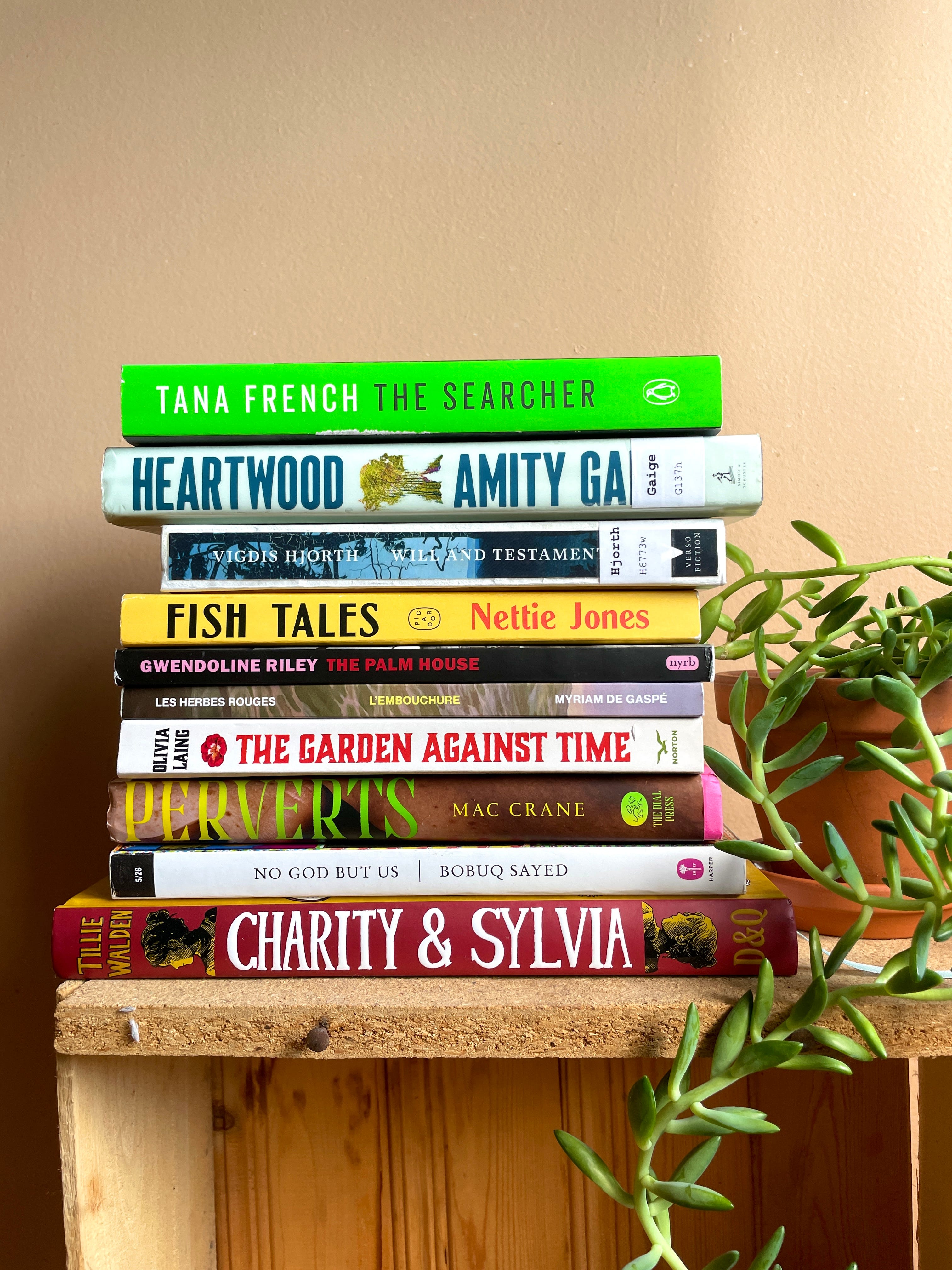
The Searcher (Tana French, 2020): Usually, my reading tends towards the plotless, the meandering, the attention-demanding, but right now I’m hankering for the strong current of a page-turner. I want to spend time with stories that provide conclusions and solutions even if they aren’t always pleasant. I figured I’d start with an Irish writer, having come to trust the Irish on both a sentence and a storytelling level. The Searcher was quite alright! A retired Chicago cop (whose narrative voice I didn’t always totally buy) tries to disappear into a quiet life in a small village in the west of Ireland—of course, a case quickly finds him, by way of a scrappy kid who shows up to his door and pressures him to help find a missing older brother. Naturally, the secret underbelly of the town is slowly exposed through our detective’s inquiries, as he wrestles with his own life regrets, which are unearthed by the case. A very familiar set-up, and thus a comforting one. A slow burn, with some nice atmospheric writing—perhaps too slow for those leaning into the thriller part of the mystery-thriller, but compelling enough to me.
Heartwood (Amity Gaige, 2024): Was pleasantly surprised to find that this novel, billed as a mystery-thriller, about a woman hiker who has gone missing on the Appalachian Trail, and her efforts to survive told in parallel with the efforts to find her, is also a novel about Covid grief. The lost hiker is an emergency room nurse, who has embarked on the long and punishing yet meditative hike to try to move through her sadness, exhaustion, anger, and feelings of impotence after years of crushing shifts on overflowing Covid wards. I haven’t come across many novels yet that deal with Covid as a central element—Davey Davis’s Casanova 20 is one exception, though a very different book from this one—so I appreciated this. I’d say that Heartwood is even less of a typical mystery-thriller than The Searcher, but it’s definitely page-turner, the narration very capably shared between several characters, and I was easily pulled in. I like a book that’s set in a very specific context—in this case the Appalachian Trail, with all its hiker lingo and rules and rituals, and the search and rescue process carried out by the wardens who have jurisdiction in the parks the trail winds through. Some very beautiful nature writing about the wilderness of Maine, too.
Will and Testament (Vigdis Hjorth, 2016, translated by Charlotte Barslund, 2019)—FYI, discussion of CSA in this section: Ugh, Vigdis. She’s truly the master of the lacerating, psychologically merciless family trauma novel. I hesitate to call this a thriller, even though it’s billed as such, because it appears to hew so closely to the author’s own life (so much so that one of her sisters, who felt maligned by it, wrote her own novel about Hjorth as revenge). But Hjorth writes the cruel, insidious logics and systems of abusive (and in this case incestuous) families with such analytical and yet also emotional precision that reading her work does feel like reading a thriller. It’s not Who did it? but rather Why and how could it have been done? and What is remembered and by whom? and Who reaps the spoils of silence? and What are the consequences of daring to speak about violence? Though the father of the family is the perpetrator of the abuse, his adult daughter Bergljot’s relationships with her mother and sisters are the more fraught and painful ones, because of the intense mixture of self-centred upset, wheedling, shaming, and denial that they meet her disclosure with, over and over throughout the years.
“In real life there is no evidence,” Bergljot thinks, as she considers Thomas Vinterberg’s film Festen, in which a man accusing his father of past abuse has indelible proof with which to confront him. “It is a great film,” Bergljot allows, “but it’s wrong.” Instead, Hjorth keeps us in the unbearable space of oscillating certainty and doubt, in which no definitive confirmation exists, in which people die without admitting to anything, in which many mothers are prone to protecting their husbands over their children, in which trusting your own memories can lead to painful familial estrangement but might also be the only way to keep living without betraying yourself.

The next two books were low on plot but high in daring and idiosyncratic character-writing.
Fish Tales (Nettie Jones, 1983): This was a breath of fresh, horny air, and a revelation. Some of the raunchiest, most playful sex writing I’ve come across in a while, some of the loneliest moments and some of the freest (sometimes both at once). No wonder Toni Morrisson took this manuscript on when Jones sent it to her in the early 1980s, on the recommendation of another underappreciated Black American woman writer, Gayl Jones. Jones (Nettie) has this way of describing a person in a couple of lines and bringing them entirely to life, jostling you aside or pulling you close in whatever room or subway car or cafe or library you’re sitting or lying in, drawing you in and bowling you over. Fish Tales’s Lewis is a party girl, a woman in close touch with her own desire, though not immune to the pain it can bring her—she moves between Detroit and New York through the 1970s, between men and women (mainly men—some of em queers though). She is exquisite company—I couldn’t get enough of her, her way with words and her ways with people, even in the moments when it seemed she’d had enough, briefly, of herself.
The Palm House (Gwendoline Riley, 2026): I picked this up, knowing nothing whatsoever about it but trusting that NYRB would come through—and oh, it did. Riley might be a new favourite of mine already. A very different text than Fish Tales, much more stiff-upper-lip-English in tone and context, but similarly concerned with the intricacies of close, fraught relationships between men and women—relationships that can’t be summed up with one word. Riley, like Jones, is able to devastate with uncannily precise descriptions of its characters’ mannerisms and affects, especially when they are behaving selfishly. Certainly not the plot-driven mystery-thriller I was after this past month, but a page-turner in its own way. I love the way Riley writes dialogue. I’m reminded of Linda Rosencrantz’s Talk, how it just lets the idiosyncratic back-and-forth between friends expand and contract until its rhythm becomes totally mesmerising. Bits of it also made me think of Withnail & I. Characters who embody a certain type of triumphant English misery—a gleeful rejoicing in misery itself.
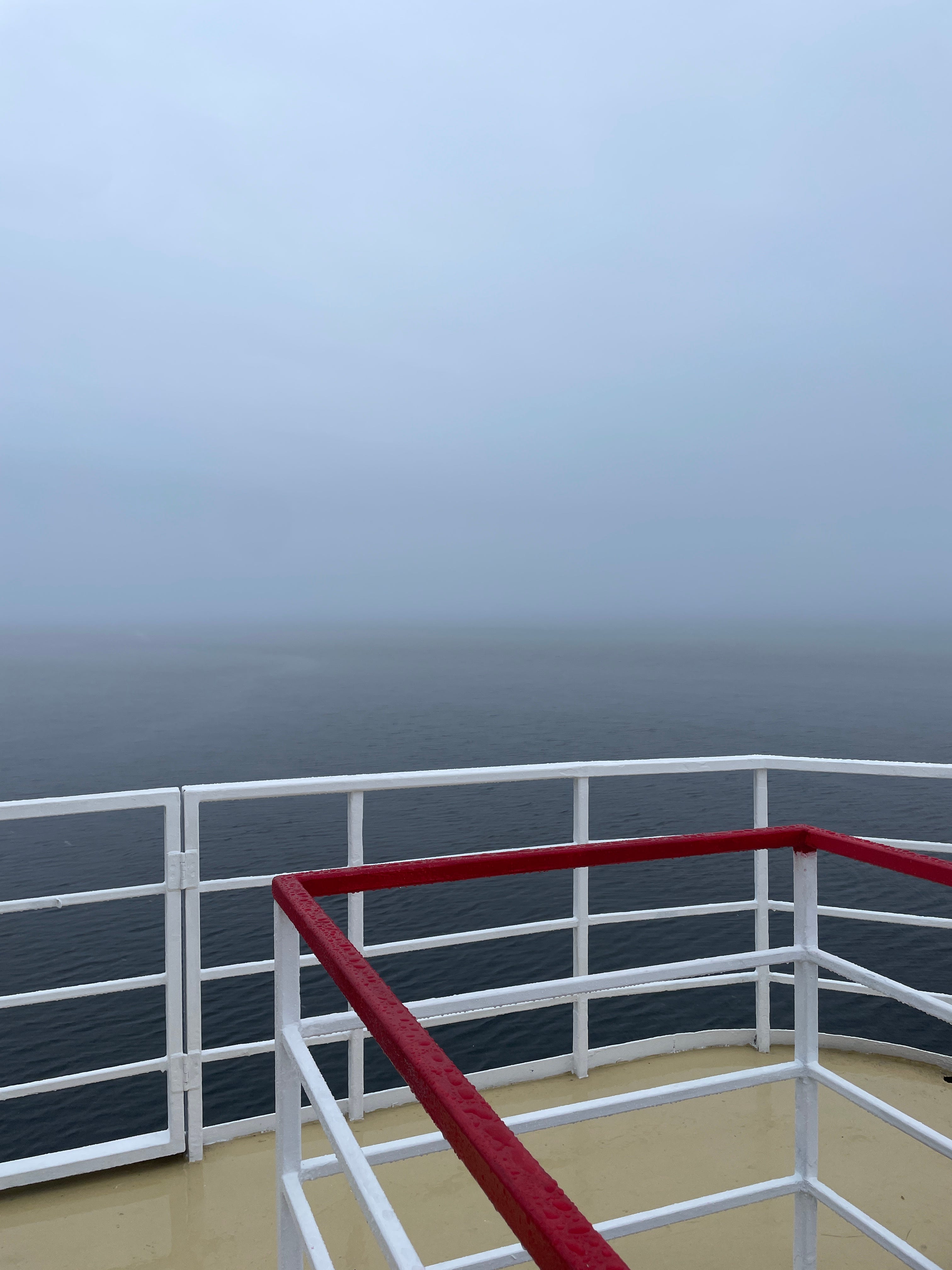
These two books were perfect companions during a recent trip up the north shore of the St-Laurent with some dear old friends.
L’embouchure (Myriam de Gaspé): I’ve been trying to read more in French, especially from Quebec, so I picked up this debut novel by de Gaspé, a writer based in Trois-Pistoles. La Malbaie, where we spent a beautiful week, is more or less across the St-Laurent from Trois-Pistoles, so that I felt unusually close to the riverine sections of the text and their environmental details and moods. Literally I was reading a passage about belugas bobbing in the waves while watching belugas bobbing in the waves from our rented balcony. The novel follows a mid-twenties neurotic queer as she tries to figure out what is stopping her from accessing intimacy with the woman she has a crush on. She moves between her Hochelaga neighbourhood in Montreal, her psychoanalyst’s office in Outremont, her father’s cabin near Trois-Pistoles, her mother’s new home in northern France, and her crush’s hometown of Marseille. I worried that this would be just a well-trodden tale of bisexual anxiety, but it’s more expansive than that, and the language is really gorgeous throughout.
The Garden Against Time (Olivia Laing): I was totally absorbed by Olivia Laing’s expansive, curious, politically rousing book about gardens past and present—which uses as a scaffolding her own long process of restoring the rambling garden at the house she shares with her partner, during the early Covid pandemic. She uses the various seasons and phases of this garden labour, which she loves despite its difficulties and frustrations, to lead the reader back in time to other English gardens—but not just to admire their flora. She traces connections and lineages between gardens and colonialism, gardens and the trans-Atlantic slave trade, gardens and early English socialism, gardens and revolt, gardens and communities of queers and other misfits. I came to Laing via her intro to one of my favourite books, Derek Jarman’s Modern Nature, which is also a book both about the slow, patient work of gardening and about so much more than gardening—a view of the world that embraces the the ugly, the melancholic, the subversive, the rebellious, the romantic. Jarman is in these pages, happily, and so are other major figures of English art and literature: John Milton, William Morris, John Clare.
For my column in Xtra (newly minted with a title: Cruising the Shelves), I reviewed Bobuq Sayed’s No God But Us and Tillie Walden’s Charity and Sylvia. Very different titles but both worth your while! Forthcoming also is my review of Mac Crane’s new short story collection, Perverts.
Albums and tracks on heavy rotation:
Secos & Molhados - Secos & Molhados, 1978: You can’t really go wrong with 70s Brazilian prog rock—this one is really doing it for me right now. (Bit confusing to locate as they have four eponymous albums; this is the third one.)
Sons of Ethiopia - Admas, 1984 (reissued in 2020): Eli turned me onto this one, by a band of Ethiopian musicians living in Washington, DC in the 80s. Perfect guitar and synth noodling to stroll to. It sounds like early summer sunlight.
(Who) Keeps Changing Your Mind? (Fresh Fruit Deep) - South Street Player, 1993: Mm just an infectious good mood.
I do not know how anyone is other than grumped+slumped at this moment. things are so 🫠.
I just read the Davey Davis book recently and was thinking how it felt like the first novel I have read that addressed COVID, or at least that did so in a way that really engaged and resonated w me, so i am glad to have another book to add to that small pile!
metonymy 5ever!