Spring reading and resisting
"I dream them here, the activists, who are recurring. I walk down this street convinced that I am on the cusp of something." - Renee Gladman

True fans will no doubt have noticed that I did not write a March newsletter. Sorry! This was due in large part to the fact that I am involved in an ongoing court case: I am part of a group of people who are fighting criminal charges for having carried out a sit-in in a Scotiabank branch in spring 2024. This action was part of a larger pro-Palestine, BDS-informed movement that successfully pressured the bank to FULLY divest (as of early 2026) from Elbit Systems, a major Israeli weapons manufacturer.
You can read some (mainstream) coverage of our case here, and if you’d like to support us, you can donate to our legal fund. Of course, if you prefer to instead donate money directly to people in Palestine (or Lebanon or Iran or Sudan for that matter), please do so!
Our sit-in was rather minor, compared to many other actions being carried out in complicit nations all over the world to resist the Zionist colonial war machine, and yet it feels important to fight these charges, if only to try to prevent other protestors from being similarly rounded up, detained, and charged in the future. Disobedience is a muscle that must be frequently exercised, as Jamila Bradley argues in this timely piece. Whether or not we win, we feel it is our moral responsibility, living as we do in so-called Canada, to push back against state and institutional support of genocide and other war crimes. The ethical and the legal have never been welll aligned, after all.
In other news, the Montreal Writers for Palestine fundraiser that I’d announced in my February newsletter had to be postponed. I can’t read on the new date, and am sad to miss it, but you should go! Thyme Travellers: A MW4P Reading Fundraiser on Wednesday, May 20th at Articule (6282 Saint-Hubert). Doors at 7:00pm, event at 7:30pm. Pricing: $25-$40 sliding scale, NOTAFLOF. In support of Bridge of Solidarity, an anti-capitalist aid org in Gaza, supporting the most marginalized Gazans, and people without phones, social media, English skills, or living family. Readings by Belen Blizzard, Noor Al-Samarrai, Elissa Kayal, and Yara Coussa.
March and April reading:
All of the time and energy and mental gymnastics required to go through this process (which is culminating now, after dragging on for over a year and a half), means that I haven’t been able to read and write (or cook or clean or work or be a good friend) as much as I would like. The books that I have read, however, have supported me by giving me new ways to think through activism, international solidarity, collective group dynamics, political strategies, emotional conundrums, creeping authoritarianism, and friendship.
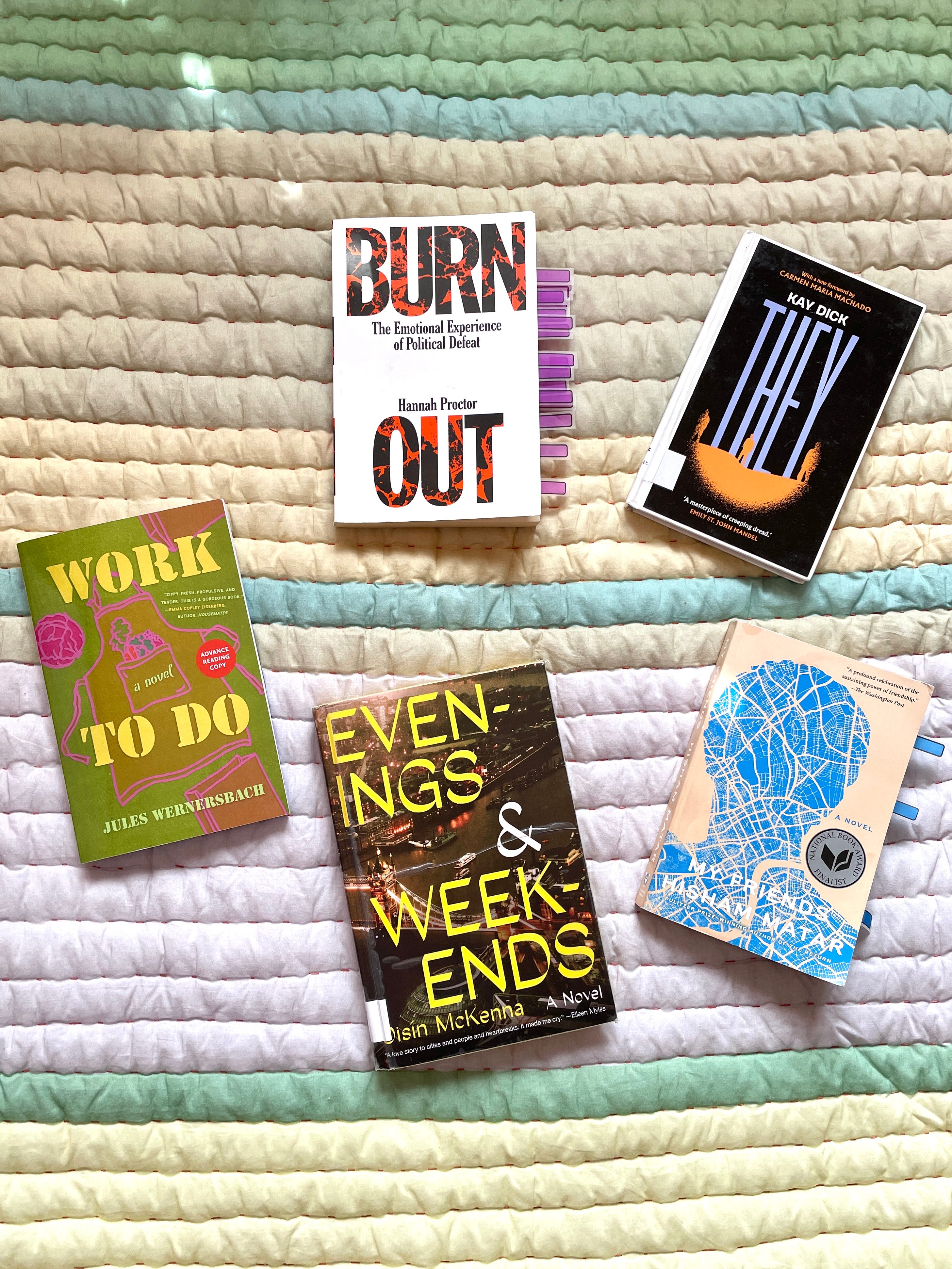
Given the current political moment (I’ve recently learned the term “polycrisis” which sounds like kind of elevated queer drama tbh), I’ve been organizing my reading a bit more thematically than usual. Like my approach to perfumes (anti-signature-scent), I tend to read along the desire paths of my mind, aided by the timing of my library holds, various recommendations from friends and booksellers, and my sagging bookshelves. Recently, however, I’ve been more focused on books about organizing and revolution—widely defined.
Hannah Proctor’s Burnout (2024), a compelling and exhaustive survey of the emotional fallout of political failure over the centuries, is central to this reading project. I’m not all the way through it yet, but reading the copious historical examples she provides, which illustrate familiar emotional terrain (e.g. nostalgia, bitterness, exhaustion, melancholia) through the ages, is, while not exactly uplifting, at least deeply companionable. As someone who engages in political action almost entirely via a sense of necessity/obligation (as in, I am rarely if ever energized by it), many of these negative emotions are painfully familiar to me. I find that Proctor is able to strike an important balance between advocating for the importance of naming and recognizing the impact of these uglier emotional tendencies, and underlining the dangers of getting bogged down in emotional discourse without concrete strategies for incorporating these feelings into movement plans. Thanks to Kriss for the rec!
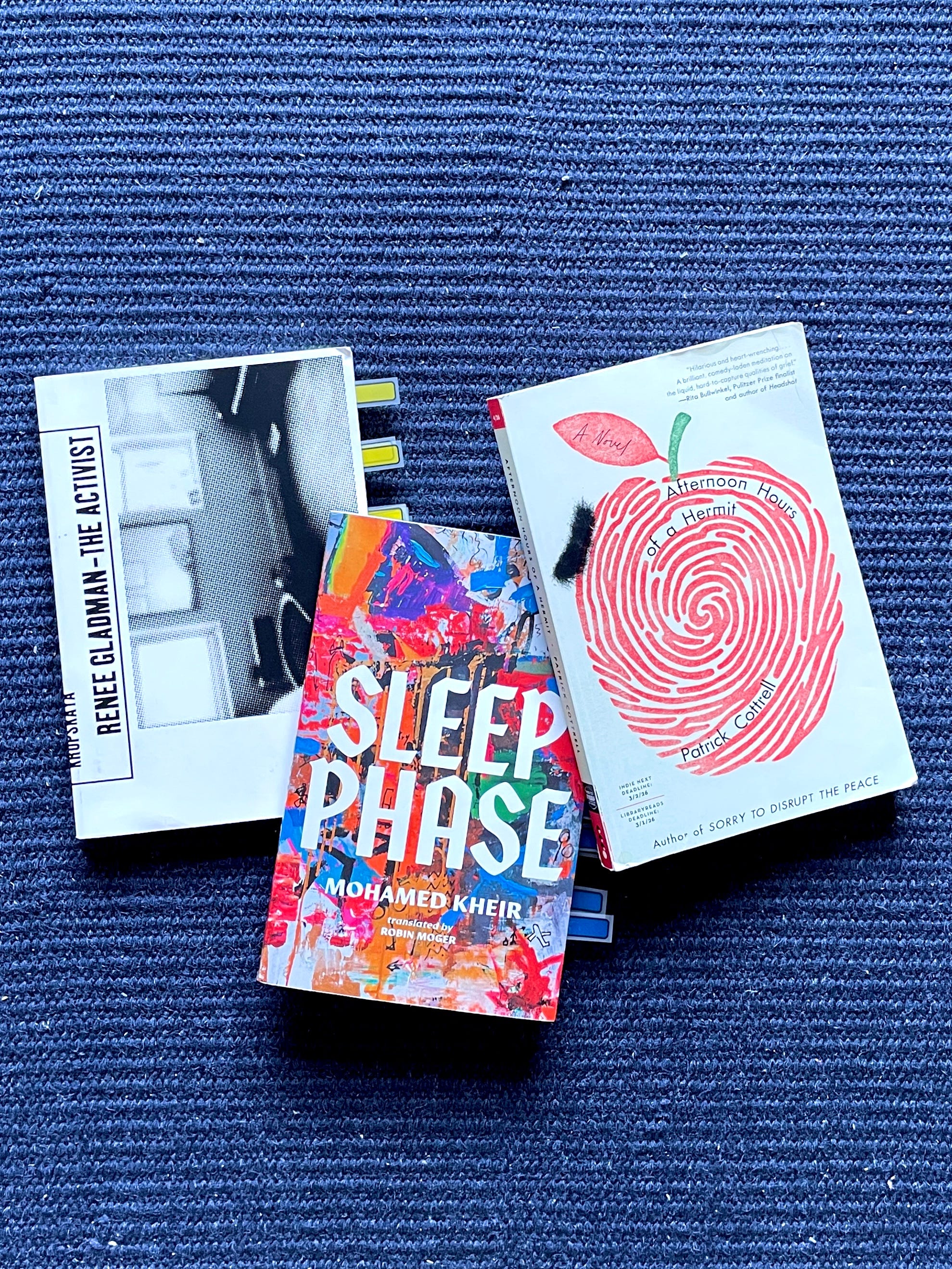
A text that engages beautifully and absurdly and poetically with the affects and choreographies of protest and organizing is Renee Gladman’s The Activist (2003), which has been an absolute boon to me over the past week, while we have been on a short break from court proceedings. I keep quelling my instinct to shout about it in our seven hundred encrypted group chats (which don’t need more messages crowding them up, I assure you). Isn’t this is exactly how it is!!! I want to tell the others. Look! This is exactly how we/they are!!! I have read The Activist before, of course, as a die-hard Gladman fan, and I remember liking it all those years ago, but now I find myself loving it much more.. intimately? Though it was written at a different time of crisis (early 2000s in the United States, the anti-globalization movement forever disrupted by the need to respond to 9/11 and the subsequent “War on Terror”), it speaks so eloquently to my current experiences—both of the sit-in action and other actions, and also of the long aftermath of this particular event—the need to engage with the press, with lawyers, with the state and other institutional structures and language, and with each other. The need to keep meeting years after the event itself, to figure out how to incorporate the fluctuating personal needs and emotions of each group member into urgent and ongoing micro- and macro-decision-making. The disorienting absurdity of the words and gestures at our disposal, while, elsewhere, with our money and the approval of our government, resisting populations are imprisoned, maimed and murdered.
Egyptian writer Mohamed Kheir was unknown to me before I picked up this gorgeous book of his, Sleep Phase (2025), a translation from the Arabic by Robin Moger. I had thought it was going to be about the aftermath of the 2011 Egyptian revolution—and in some ways, perhaps it is, but less concretely and more emotionally, veering into the bizarre and the surreal. Warif is released after seven years of imprisonment for a cryptic “crime” and finds Cairo, his hometown, to be almost unrecognizable—aside from his trusted friend Wagdi. This is not a gritty post-revolution dystopia. Warif’s days are peaceful, perhaps more peaceful than they were before his imprisonment. And yet something is off. The prose is incredibly lush, a and Kheir’s imagery is startling and beautiful, lulling us into an acquiescent mood—only to reveal the insidious authority underneath the revised city streets.
Hisham Matar’s My Friends (2024) deals with the Arab Spring and longterm friendships between men in a much more straightforward manner. Set mainly in London, over several decades, it follows the lives of three friends—all Libyans living in exile due to their public opposition to the Qaddafi regime back home. I felt the novel worked well as a study of friendship over time, of how the political views and actions of those close to us can indelibly change us as well, how the weight of exile and the urgency of revolutionary action can either bring friends much closer together, or create unbridgable distances between them. I’m not sure that I found it to be a politically incisive text—I would have been interested to read more about Qaddafi’s political trajectory and his rise to power (the book doesn’t touch on his original commitment to an anti-colonial, pan-Arabist and then pan-African ethos, and how he was eventually, ironically, assassinated by a national movement galvanized by the Arab Spring). Instead, Matar treats him solely as an authoritarian dictator (which he was, of course), in opposition to the supposed democratic freedoms of western Europe. The novel’s female characters are thinly drawn, compared to the three male protagonists. There was also an emptiness in the middle section of the book, which I found a bit tedious to get through. Perhaps this was meant to project the hollowness of exile, but I thought it could have used a jolt of energy.
Admittedly, I was drawn to Kay Dick’s They (1977) because of the title. How nonbinary! But in fact the “they” in question are the straights—the mindless, creeping crowd of normies who, directed by no one in particular, encroach on the lands, homes, families, studios, and art practices of the disparate protagonists of these interconnected stories. Or is it a novel? It’s a novel in the French way—less a question of plot and narrative arc than a prevailing mood, scattered across brief, unsettling sketches. It’s very English too, though—I’m reminded of Ann Quin and Eva Figes, and especially of Anna Kavan and her novel Ice, which is similarly set in a dystopia that is never fully described to the reader, and that barely seems to be understood by its characters, much in the way that most of us have an imperfect understanding of the shifting structures of authority that govern us. It took me a moment to get into They, but it soon won me over with its refusal to explain itself. Dick’s decision not to provide any clear reason for why the artists, queers and weirdos are being constrained and surveilled by the rest of the population is much more unsettling than any “evil genius” or “secret cabal” reveal could be. There’s a great write-up in Xtra about They and about Dick herself—who among us can resist learning more about a prickly, literary bisexual?
I realized that I was reading Jules Wernersbach’s Work to Do (2026) and Oisín McKenna’s Evenings & Weekends (2025) at the same time—books that complement each other kind of perfectly. I reviewed Work to Do for my column in Xtra, so I won’t get into here other than to say that it’s great, and that I want more queer novels like it that really plunge into the nitty-gritty details of wage labour and workplace organizing amidst all the regular dating and family drama! Like Work to Do, Evenings & Weekends features a dizzing cast of characters, many of them queer; instead of navigating workplace dynamics, they are navigating all the other dynamics that emerge when the workday is over. I picked it up because I’ve been reading a lot more Irish literature ever since my residency in County Monaghan last October—and found myself enthralled. Like Work to Do, it’s a supremely assured debut novel, and displays an immense attunement with all of its characters, across class, sexuality, and gender (if not race). Taking place mainly over a sweltering London weekend in summertime, it delves into the various longterm emotional entanglements of its many protagonists, undoing some knots while tightening others. Really kinetic in the way that it vaults between points of view, and truly tender without being sappy. Actually inspiring to me as I wrestle with my own emotionally charged, multi-character queer novel.
Patrick Cottrell’s brilliant Afternoon Hours of a Hermit (2026) was also helpful to me in my ongoing novel-tinkering, for different reasons. It’s kind of the opposite of Evenings & Weekends, in that its first person narrative is almost claustrophobically zoomed in. And yet, no, not the opposite—it’s just a different way of digging around in the emotional pit that many (all?) of us queers and trans people and gender nonconformers carry around inside of us. I reviewed Afternoon Hours of a Hermit for Xtra, if you want to read my lengthier thoughts about it there.

Songs on repeat:
Eli and I saw the tremendous Laraaji in concert a few weeks ago. Clad in his signature orange, he played (zither and other things) for an hour and a half or so, barely spoke, though he laughed, which is an integral part of his music, and did a sort of undulating dance when we stood up to applaud him. Hearing him play reminded me to (re)start playing music at home. Court procedings are the opposite of music and the opposite of dancing, so that this past month, I forgot briefly that I could do things other than sit on hard wooden pews and be explicitly and implicitly told off by the state. We sat in wooden pews to hear Laraaji play (at the St. James Church on Ste-Catherine), but it was entirely different. We didn’t have to be there—we had chosen to be.
Just the slow layers and the way they bend and change, the emotion of it. I come back to this track every so often, and am astounded every time.
Nasty - John Silas, Marquinn Mason
It’s just past 4 a.m. and you’re still on the dancefloor, in fact maybe you’re just getting going—the crowd has thinned out, the loud talkers and the phone users have departed, and those who remain are here to stay. I did go dancing recently, down by the port, in a huge space with big windows and a fire alarm that someone kept pulling all night, just to be an asshole, presumably. Nonetheless, I was able to enter that blissful state of automatic movement that can take me over when good house music goes all night long.
Love Is Everywhere - Pharoah Sanders
Listen to this all the way through and tell me it isn’t one of the best songs ever recorded.
If you have TIDAL, you can listen to my spring playlist.

I’ve been trying to spend less time on social media and in drainpipe of doomscrolling and I just really loved reading this newsletter as an alternative. I’m leaving with many books on hold from the library, songs lined up to play, and a little bit more lightness. — Wish I could be there in person to support you all in the courts.